
Internet Explorer 11 (IE11) is not supported. For the best experience please open using Chrome, Firefox, Safari or MS Edge

Article Insight

Key trends from the Courts Service Annual Report 2025 Debt recovery update

Insights Debt Recovery 11 Aug 2026

In an environment of rising costs and economic volatility, cash flow management is critical. Early intervention can mean the difference between business survival and failure. Our Debt Recovery team examines creditor activity trends from the recently published Courts Service Annual Report.

What you need to know

  • The Courts Service Annual Report 2025 notes slight increases in the level of creditor litigation and enforcement activity in the Irish Courts.
  • Default judgments obtained by creditors rose by 21% year-on-year, though many of the extra judgments are at District Court level.
  • Repossession proceedings by lenders also rose in 2025.
  • Corporate and personal insolvency numbers remained flat, staying at their lowest levels in many years. This is notable given ongoing cost and payment pressures on businesses, and reflects the continued resilience of the Irish economy in 2025.
  • Early action on distressed debt yields the best dividends for creditors.

Courts Service Annual Report 2025

The recently published Courts Service Annual Report 2025 offers a comprehensive overview of litigation activity across Ireland for the previous calendar year. The Report noted that new civil matters increased by 2% year-on-year to 187,639. The wider backdrop is, of course, the performance of the Irish economy in 2025, which performed strongly despite the prevalence of considerable global economic volatility, intense uncertainty and higher costs.

Debt collection litigation numbers

The Report provides useful insight into how creditors utilised litigation and enforcement mechanisms in the Irish Courts in 2025. Figures for default judgments have told a familiar story about the Irish economy over the past two decades, and the 2025 figures show no major changes in that regard. Indeed, the Report notes that there was an overall 4% decline in what it describes as “actions to recover debt” that the Courts issued.

Since the Covid-19 pandemic, annual default judgments had stabilised at around 8,000. However, 2025 saw a 21% increase, the largest in many years, with 10,014 judgments obtained. The vast majority of this increase (1,515 judgments) occurred in the District Court, where claims are capped at €15,000, reflecting conservative credit limits applied by businesses and lenders in recent years.
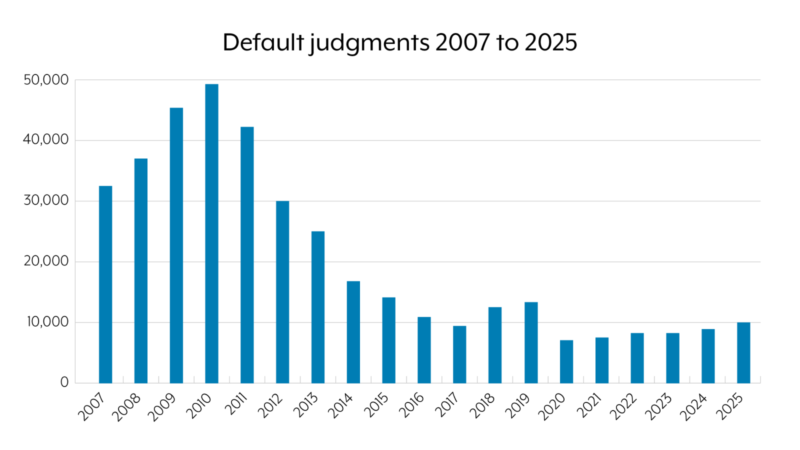
Default judgments 2007 to 2025

Property repossessions by lenders

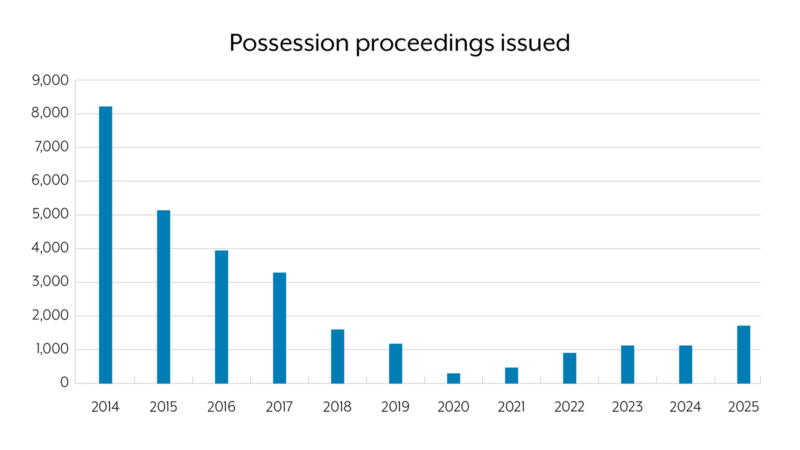
Looking at the figures for property repossessions on foot of court orders, there was a small but sizable year-on-year increase in the number of orders (from 1,135 to 1,650) made by both the High and Circuit Courts. However, the 2025 figures are still considerably less than their equivalents from 10 to 12 years ago.

Possession proceedings issued

Enforcement and insolvency

Other figures across the report relating to creditor litigation and enforcement tell a similar story of a slight increase in activity in 2025. This uptick is seen in a single figure percentage rise in the number of bankruptcy self-petitions by debtors and the number of judgment mortgages registered by creditors. The volume of court-based corporate insolvencies fell also, with both examinerships and court liquidations down on 2024. Interestingly, there was a 27% increase in the number of judgments actually published. It is hoped that those publications will help drive better credit decisions in the future.

Our observations in 2025/2026

These trends are consistent with increased activity in our practice. Enquiries and pricing requests from business creditors rose throughout 2025 and into 2026, driven by inflationary pressures and growing cash flow challenges as operating costs increased.

However, court judgments are more than just records of unpaid debts. They provide valuable insight into financial behaviour, economic pressures and the challenges faced by individuals and businesses. There is no doubt that macroeconomic conditions contributed to that behaviour and those pressures in 2025. We would suggest that by analysing publicly available data, including litigation and enforcement data, creditors can better understand trends and patterns that contribute to more informed decisions.

Comment

Businesses often delay taking action when early signs of debtor distress emerge, such as requests for credit term extensions, late or erratic payment patterns, and invoice disputes. While civil disputes are rising, as the Report highlights, an invoice dispute should not prevent you from pursuing recovery.

For expert debt recovery assistance, contact our Debt Recovery team.

The content of this article is provided for information purposes only and does not constitute legal or other advice.