
Internet Explorer 11 (IE11) is not supported. For the best experience please open using Chrome, Firefox, Safari or MS Edge

Article Insight

Navigating high-low brand collaborations Audemars Piguet x Swatch

Insights Intellectual Property 29 Jun 2026

Luxury brand collaborations can create strong commercial opportunities, but they also carry risks around exclusivity and brand control.

The Audemars Piguet x Swatch ‘Royal Pop’ pocket watch collaboration demonstrates how structural product design can help manage dilution risk while opening a brand to new audiences.

Our Intellectual Property team examines how IP enables heritage brands to engage new demographics while protecting their core asset exclusivity.

What you need to know

  • Product category: Luxury brands can protect core markets by ensuring that mass-market collaborations focus on alternative or tangential products, preserving the integrity of their core product offering.
  • Design choices can protect brand value: Using recognisable heritage features in lower-cost materials can help brands reach new customers without weakening the value of their core luxury products.
  • Re-investing proceeds can protect reputation: Using licensing revenue to support preservation or heritage initiatives can help show that a collaboration is not just a mass-market commercial exercise.
  • Supply chain safeguards: High-low manufacturing agreements require strict material specifications to ensure entry-level products do not mimic luxury tactile quality.

High-low collaborations

High-low collaborations are partnerships between a high-end or luxury brand and a more accessible, mass-market brand. The aim is usually to allow the luxury brand reach a wider audience while giving the mass-market brand added prestige and cultural relevance.

The ‘Royal Pop’ framework

The recent release of the ’Royal Pop‘ convertible pocket watch collection by Audemars Piguet and Swatch highlights a new strategy in high-low luxury collaborations which differs from previous Swatch collaborations. For example, when Swatch ran a collaboration with Omega, they created the MoonSwatch which was a direct, 1-to-1 physical replica of the iconic Speedmaster silhouette. Specifically, that model maintained the exact dimensions, asymmetric case, and "Dot Over 90" bezel of the luxury original. While the MoonSwatch gained huge press and public interest, it risked narrowing the "sovereignty gap" between a €300 plastic watch and a steel mechanical watch worth €8,000. This aspect of the collaboration provoked purists to argue that it diluted Omega's prestige.

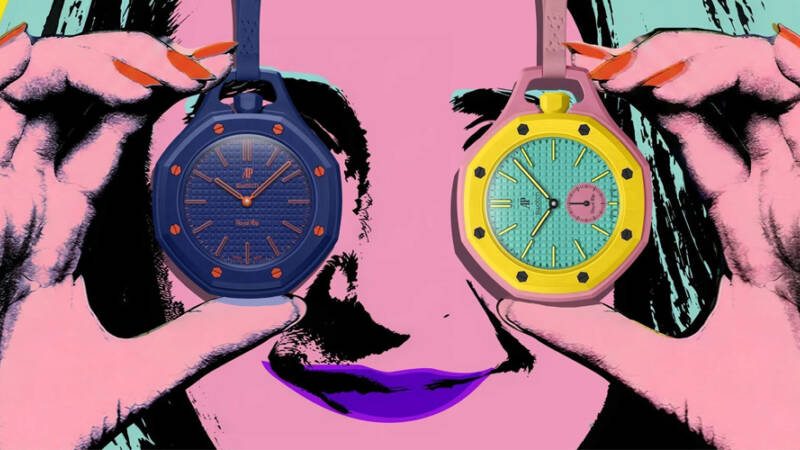
The ‘Royal Pop’ completely eliminated the risk of direct substitution by changing the product category. Instead of releasing an entry-level wristwatch similar to the ‘Royal Oak’, they engineered a modular, convertible pocket watch that can be worn as a pendant or desk clock. A consumer cannot buy the Swatch version as a cheap "stand-in" for a luxury Audemars Piguet wristwatch because the form factor is fundamentally different. The ‘Royal Pop’ modular pocket watch design successfully created a distinct lifestyle product which avoided direct market crossover with the primary product lines that sustain the luxury brand's valuation.
Preserving core trade dress

The ‘Royal Pop’ collection explicitly incorporates some primary visual markers of the historic ‘Royal Oak’ line, including the octagonal bezel, hexagonal screws, and the "tapisserie" dial pattern. To protect the premium asset from dilution, these design cues are executed entirely in synthetic bio-ceramic materials rather than precious metals or hand-finished steel. This material contrast ensures the consumer public can easily distinguish the high-volume novelty item from the core luxury trade dress. Interestingly, rather than employing a low-cost quartz movement, the Royal Pop collection utilises a reconfigured, hand-wound mechanism which forces the consumer to manually wind the pocket watch in order for it to function.

By restricting initial availability to select physical retail locations, the enterprise created deliberate distribution barriers that maintained market scarcity. This tactic generated high consumer demand without relying on digital sales channels.

Contractual ring-fencing of proceeds

Co-branding agreements involving high-end luxury assets can attract negative commentary regarding the effective cheapening of a brand. To protect corporate reputation, Audemars Piguet directed its entire share of licensing profits directly into an independent foundation dedicated to preserving rare horological craftsmanship skills. This contractual arrangement allowed enormous public interest while insulating the luxury house from any claims of brand exploitation by aligning the mass-market product release with the long-term preservation of the brand's core heritage.

Licensing protections against brand drift

To execute a luxury partnership without causing long-term market confusion, corporate counsel must anchor the master licensing agreement within rigid protective parameters. We recommend considering:

  1. Category restrictions: The contract should explicitly restrict the licensee to non-typical formats to prevent direct substitution risks.
  2. Material monopolies: The licensor should retain exclusive rights over specific finishes and techniques, banning or controlling their replication in cheap materials.
  3. Logo use limits: Joint branding must always display both corporate trademarks concurrently. This prevents the licensee from utilising the premium logo in isolation.

Conclusion

Ultimately, the Audemars Piguet x Swatch ’Royal Pop‘ collaboration demonstrates that a luxury brand does not have to sacrifice its heritage to engage with a mass-market demographic. Where previous high-low partnerships risked brand dilution by offering direct, accessible alternatives to core products, this modular pocket-watch framework takes a different approach. It shows that product design can include deliberately defensive features, supported by clear licensing arrangements. The ‘Royal Pop’ collaboration serves as a masterclass in modern intangible asset curation, proving that with strong contractual guardrails, key product category segregation, and an overall commitment to brand integrity, even a heritage brand can safely go "pop" without losing its crown.

For expert advice regarding luxury brand licensing, trademark enforcement strategies, or intellectual property protection, please contact a member of our Intellectual Property team.

The content of this article is provided for information purposes only and does not constitute legal or other advice.

How can luxury brands use category shifting to mitigate trademark dilution in mass-market collaborations?
Move high-volume partnerships entirely out of their primary product class, preventing direct market substitution. By switching to an alternative product form, the enterprise creates a clear boundary between its volume novelty items and the exclusive trade dress of its primary assets. 

This category segregation ensures that mass-market consumers can engage with the brand's design DNA without creating a cheap, functional "dupe" or substitute for the core luxury collection.
What are the key intellectual property risks when a luxury brand licenses historic trade dress to mass-market partners?
The primary intellectual property risks in product collaborations can include brand dilution or blurring, and the erosion of distinctive trade dress characteristics, as well as secondary design liability.

When a luxury brand licenses historic visual markers to a fast-moving retail partner, there is always a risk of losing exclusive control over its quality standards. Therefore, clear communication of expectations and strict contractual conditions are strongly advised.

Mass-market manufacturing often relies on lower cost composite or synthetic materials. If the licensee replicates premium designs more cheaply, the public association between the trade dress and luxury craftsmanship may be weakened. To mitigate this risk, master licensing agreements must enforce absolute approval gateways over every physical sample and digital asset.

It is also important to ensure clear agreements around co-branding. For example, it is critical that the premium brand’s trade marks are never displayed in isolation on a cheaper product to avoid blurring. Conversely, the cheaper mark should not be used in isolation on a premium design.
Are high-low collaborations worth the risk? What’s to gain?
From a corporate perspective, they can be, provided the brand architecture is carefully controlled.

The commercial upside is clear. Campaigns such as Omega x Swatch “MoonSwatch”, Blancpain x Swatch “Fifty Fathoms” and the recent AP x Swatch “Royal Pop” show how luxury brands can reach new audiences, generate cultural relevance and create demand beyond their traditional customer base.

The key is to ensure that the collaboration expands brand visibility without creating a direct substitute for the core luxury product.